




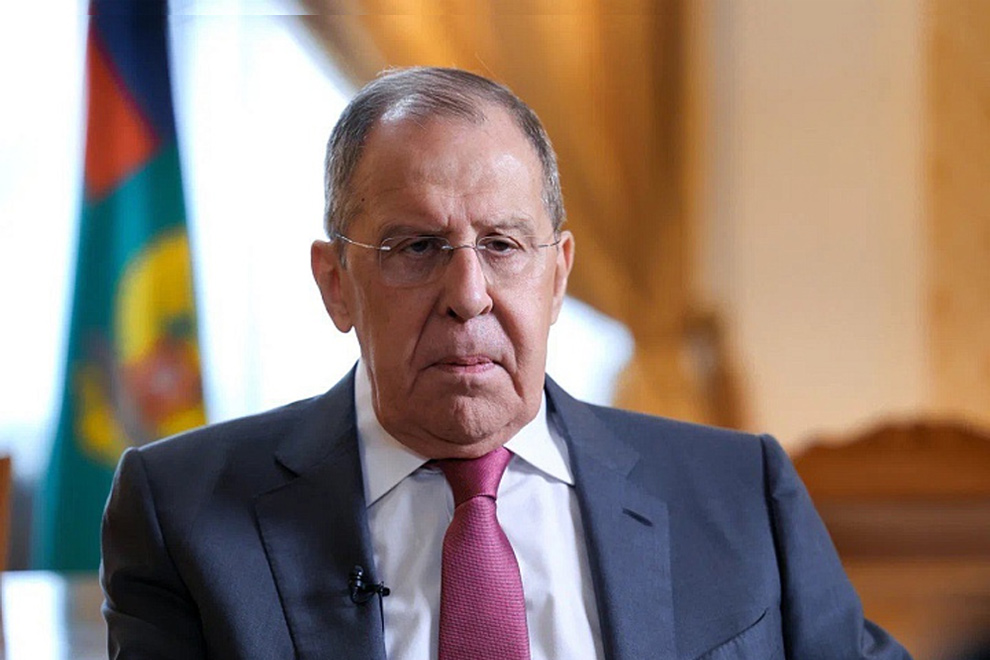
Russian foreign minister Sergey Lavrov gave a wide-ranging interview to Russian media outlet RIA Novosti on November 9. Russian foreign ministry
Sergey Lavrov, Minister of Foreign Affairs of the Russian Federation, sat down for an interview with media outlet RIA Novosti on November 9. In this interview, he discusses several global issues and explains how peace can be achieved. This piece has been edited for brevity and clarity.
Vladimir Putin, President of the Russian Federation, announced that the Russian Federation is prepared to continue adhering to the restrictions established by New START for one additional year, starting February 5, 2026. Has there been any response from the United States? Did Moscow propose a meeting with Washington to discuss the post-New START period? If so, at what level?
Sergey Lavrov: The constructive initiative put forward by President Vladimir Putin in the post-New START context speaks for itself. It contains no hidden agenda and can be understood perfectly clearly. Its practical implementation would not require any special additional efforts. Therefore, we do not consider it necessary to hold in-depth discussions on this proposal.
The only thing required is reciprocity from the US: We will voluntarily adhere to the restrictions only if, and precisely for as long as, the other side does the same. Naturally, should the Americans have any questions, they are free to raise them with us.
So far, there has been no substantive response from Washington. We have been informed through diplomatic channels that “the issue is under consideration”.
We have no intention of continuing to persuade anyone. We believe that our step serves the interests of both parties and the entire international community. We are ready for any development of events, while hoping for a positive outcome.
What is currently the main stumbling block in the negotiations with the US on a settlement around Ukraine? Where is Russia ready to make concessions and where is it not?
Sergey Lavrov: The understandings on Ukraine reached during the Russia-United States summit in Anchorage, Alaska, on August 15 were based on the conditions for a fair and lasting settlement that President Putin outlined back in June 2024 during his meeting with the leadership of our ministry. We also took into account the proposals transmitted shortly before the Anchorage meeting by US Presidential Special Envoy Steve Witkoff.
At that time, the American side assured us that it would be able to ensure that Vladimir Zelensky would not obstruct the achievement of peace. Apparently, certain difficulties have arisen in this regard. Moreover, as we understand, Brussels and London are attempting to persuade Washington to abandon its intention to resolve the crisis through political and diplomatic means and to fully engage in efforts to exert military pressure on Russia; in other words, to finally join the “war party”.
We are currently awaiting confirmation from the US that the Anchorage agreements remain in effect. I would emphasise that, despite their essentially compromised nature, we have not abandoned – and do not intend to abandon – the points that are fundamental for us. The American side is well aware of this. No one disputes the territorial integrity of the Russian Federation or the choice made by the residents of Crimea, Donbass and Novorossiya, who made the historic decision to reunite with their homeland through the referendums in 2014 and 2022. We likewise do not forget the need to eliminate the root causes of the conflict, which we have repeatedly highlighted.
What will be Russia’s response if the frozen assets of the Russian Federation are directed to support Kiev?
Sergey Lavrov: It is no longer surprising to see the cynicism with which the European Commission interprets the UN Charter and other norms of international law, including provisions concerning sovereign immunity and the inviolability of central bank assets. Such actions amount to outright deception and theft. It seems that the long-dormant instincts of colonialists and pirates have reawakened among Europeans. No matter how the scheme for seizing Russian funds is presented, there is no lawful way to carry it out.
The confiscation of our gold and foreign currency reserves will not save the united Europe’s protégés in Kiev. It is obvious that this regime will be unable to repay its debts or service its loans. There are few within the EU who are eager to blindly take such steps, which also entail serious reputational risks for the eurozone as a territory of economic activity.
Russia will respond to any predatory actions appropriately, in accordance with the principle of reciprocity, our national interests and the need to compensate for the damage caused to us. We hope that Brussels and other Western capitals will still come to their senses and abandon this ill-advised venture.
Has the US administration informed you of its readiness to recognise Crimea de jure as Russian territory as part of the peace plan?
Sergey Lavrov: For obvious reasons, we do not disclose the details of our discussions with the American side on the Ukrainian issue. However, when clearly fabricated stories appear in the media, we naturally provide clarifications. The discussion covers a broad range of issues and is by no means confined to a single topic, although some journalists and analysts attempt to portray it as such, which is fundamentally incorrect.
Let me repeat: in our view, ending the conflict is impossible without fully taking into account Russia’s legitimate interests and addressing its root causes. As for Crimea and Sevastopol, the residents of the peninsula exercised their right to self-determination in the March 2014 referendum, voting in favour of reunification with Russia. So, the issue of who the peninsula belongs to is resolved for us.
When and where could a meeting between the Russian and American delegations on mutual “irritants” take place? What about your meeting with US Secretary of State Marco Rubio? When and where might it be held?
Sergey Lavrov: There are indeed many irritants in Russia-US relations, most of them inherited from the previous US administration. It will take considerable time to clear up this mess.
With the arrival of the new administration, we have noted its certain readiness to resume dialogue. It is underway, although not as rapidly as we would prefer. Two rounds of consultations took place in the spring, with a number of agreements reached to improve the conditions for the operation of our diplomatic missions.
From our perspective, it is important that this dialogue should not be limited solely to embassy-related issues. We consider it essential to address broader questions, including the restoration of direct flights and the return of Russian diplomatic property that was illegally seized by the Obama administration in December 2016, just three weeks before the first inauguration of Donald Trump.
At that time, then-National Security Advisor-designate Michael Flynn contacted our ambassador and, on behalf of the incoming US president, urged us not to respond sharply to the outgoing Democratic administration’s provocations, saying they would sort everything out upon moving into the White House. We are still waiting. Our proposals regarding both diplomatic property and air service have been conveyed to the American side. We remain in working contact concerning the possibility of continuing dialogue.
Secretary of State Marco Rubio and I share an understanding that maintaining regular communication is essential, both for discussing the Ukrainian issue and for advancing the broader bilateral agenda. We remain in contact by telephone and are prepared to hold in-person meetings whenever necessary.