




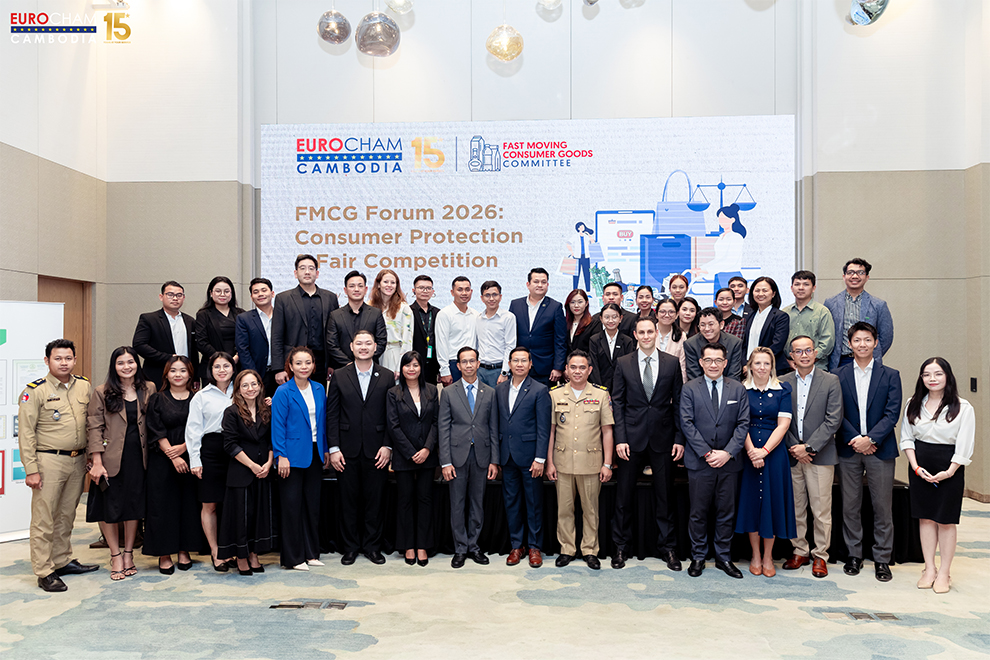
Participants attend the EuroCham FMCG Forum 2026 on January 30, where government officials, industry leaders and consumer advocates discussed how recent regional developments, including the Cambodia–Thailand border situation, are impacting supply chains, product availability and consumer trust. Supplied
Cambodia’s fast-moving consumer goods (FMCG) sector is facing mounting pressure as border disruptions and illicit trade expose weaknesses in consumer protection and market enforcement, participants heard at the EuroCham FMCG Forum 2026 on January 30.
Organised by the European Chamber of Commerce in Cambodia (EuroCham), the forum brought together senior government officials, industry leaders and consumer advocates amid growing concern that recent regional developments — particularly the Cambodia–Thailand border situation — are affecting supply chains, product availability and consumer trust.
Opening the forum, EuroCham executive director Martin Brisson said the FMCG sector, which reaches millions of Cambodian consumers daily, is increasingly vulnerable to market shocks and regulatory gaps.
“Cambodia’s consumer market is evolving rapidly, shaped by regional trade developments, changing consumer behaviour and growing concerns around product authenticity,” Brisson said.
“Recent events — notably the Cambodia–Thailand border situation — have had very concrete impacts on supply chains, product availability, and consumer sentiment,” he added.
He stressed that closer cooperation between government, businesses and consumer organisations is essential to safeguard a fair and transparent marketplace, warning that disruptions can create openings for counterfeit and illicit products to enter the market.
The concerns were echoed by government representatives, who acknowledged that market volatility and cross-border disruptions have heightened risks for consumers.
Buon Sarakmony, secretary of state at the Ministry of Commerce, reaffirmed the government’s commitment to enforcing consumer protection laws and strengthening regulatory compliance across the FMCG sector.
Throughout the morning sessions, speakers examined how shifting trade flows and supply shortages have influenced consumer behaviour and brand loyalty, while also encouraging informal and illicit market activity.
According to EuroCham, market experts noted that as established supply chains are disrupted, new and sometimes unregulated players may fill gaps, increasing the risk of unsafe or counterfeit goods reaching consumers.
It said officials from relevant ministries outlined ongoing and planned measures to tighten oversight, including stricter product registration, improved retail practices, clearer import procedures and enhanced consumer information requirements.
Practical tools such as improved packaging standards, barcode-linked product information and digital engagement were highlighted as ways to help consumers make more informed purchasing decisions.
Two high-level panel discussions brought together representatives from the commerce ministry, as well as the Ministry of Information, Ministry of Industry, Science, Technology & Innovation, the General Department of Customs and Excise and the Ministry of Interior, alongside private sector leaders from Danone Specialized Nutrition, HEINEKEN Cambodia, Unilever Cambodia and JT International.
Panellists agreed that addressing illicit trade and unfair competition has become more urgent in the current climate.
They warned that counterfeit food and FMCG products not only pose risks to public health, but also undermine legitimate businesses and erode consumer confidence in the formal market.
Afternoon sessions focused more closely on illicit trade, with discussions highlighting how recent disruptions have exposed vulnerabilities in enforcement and coordination.
Participants called for stronger cooperation between customs authorities, law enforcement agencies and the private sector to close regulatory gaps and ensure a level playing field.
Closing the forum, EuroCham FMCG Committee chairperson Sothea Rami Sambath said open dialogue and evidence-based discussion are critical as Cambodia navigates an increasingly complex consumer market.
“Combating illicit trade and strengthening consumer protection are essential for sustainable growth,” he said, reaffirming EuroCham’s commitment to continued engagement with government partners and industry stakeholders.
The FMCG Forum 2026 underscored growing consensus that protecting consumers amid market disruption will require coordinated action, stronger enforcement and greater transparency — particularly as external shocks continue to test the resilience of Cambodia’s supply chains and regulatory framework.