




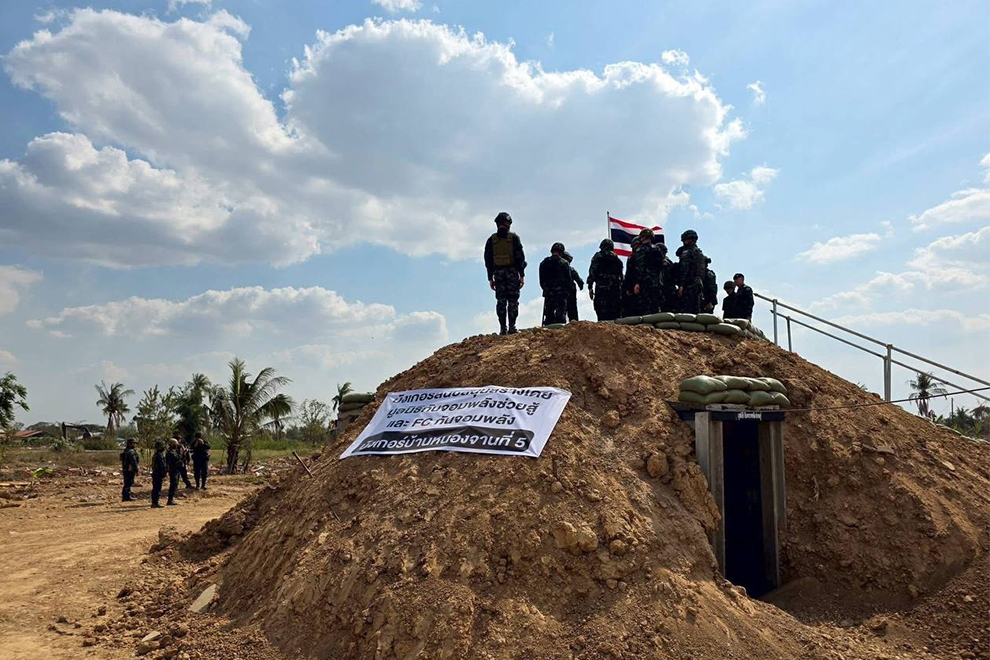
Thai military appear to be constructing new fortifications in the areas it occupied after the ceasefire. Supplied
Ceasefires are not tactical intermissions. They are binding political commitments designed to freeze positions, prevent escalation and create space for diplomacy. Any attempt to alter realities on disputed ground after such understandings — however incremental — undermines trust and risks reigniting confrontation.
Recent developments along the Cambodian-Thai border have prompted serious concern that unilateral activities are continuing in areas where sovereignty remains unresolved. Infrastructure construction, redeployments or administrative changes carried out under the cover of calm are precisely the kinds of actions international practice seeks to prevent. Creating facts on the ground while negotiations remain incomplete is incompatible with good-faith conflict management.
The governing principle is well established in international relations: parties to a dispute must refrain from acts that aggravate or extend it. This obligation is reflected in customary international law and repeatedly affirmed in regional and global precedents. It is also embedded in ASEAN’s norms of restraint, consultation, and peaceful settlement of disputes — norms Thailand has long endorsed.
Cambodia has insisted that all outstanding border questions be handled through existing bilateral mechanisms, including joint technical survey teams and boundary commissions. These frameworks were designed to ensure transparency and mutual consent. Sidestepping them through unilateral moves weakens their credibility and raises the risk of miscalculation.
Thailand is a major regional actor with a strong record of diplomacy. Precisely for that reason, its current course — if allowed to persist — will attract international scrutiny. The issue is not tactical advantage; it is whether commitments are honoured in full, not selectively.
A durable settlement requires more than calm rhetoric. It requires concrete restraint on the ground: an immediate freeze on activities in contested zones, the reversal of measures that consolidate control and the prompt reactivation of joint verification mechanisms. Confidence-building steps — rather than quiet advances — are the only sustainable path forward.
Border communities on both sides have already paid a price for instability. Renewed tension would harm trade, disrupt livelihoods, and burden ASEAN’s broader agenda at a moment when the region can ill afford new flashpoints. Stability is a shared interest; unilateralism is not.
History offers a clear lesson: Faits accompli rarely resolve territorial disputes. More often, they entrench suspicion, provoke countermoves and shrink the space for diplomacy. The international community has seen this pattern too many times to mistake it for pragmatism.
Cambodia remains committed to peaceful resolution and to all agreed ceasefire understandings. It now calls on Thailand to demonstrate the same resolve — by halting unilateral actions, respecting existing frameworks in their entirety and returning decisively to negotiated processes.
Peace is not secured by quietly shifting lines on a map. It is secured by law, restraint, and mutual consent.
Roth Santepheap is a geopolitical analyst based in Phnom Penh. The views and opinions expressed are his own.