




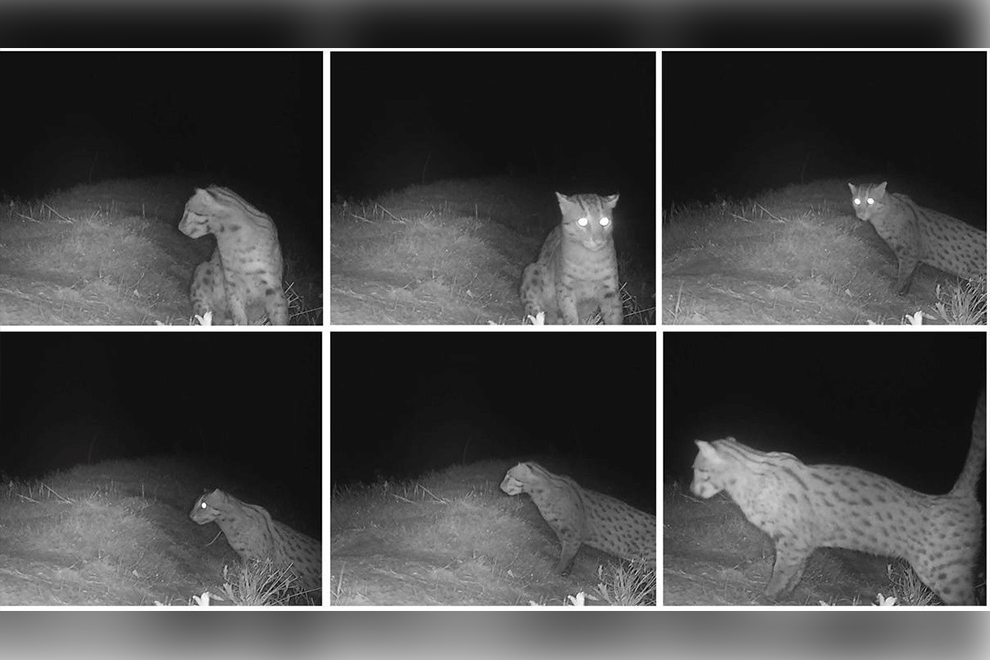
Images of a fishing cat recently that were recently caught by camera traps in Pursat province. Supplied
The fishing cat (Prionailurus viverrinus), one of Asia's rarest small wild cats, has been confirmed for the first time in the restored flooded forests of Pursat province, around the Tonle Sap Lake, through 46 photos captured by camera traps in mid-2025.
“This is a significant discovery confirming the positive results of more than a decade of management efforts, through close cooperation between the Ministry of Agriculture, Forestry and Fisheries and the Ministry of Environment, as technical advisors to Conservation International (CI)”, said a joint press release issued today, February 2.
Vanessa Herranz Muñoz, director of the Fishing Cat Ecological Enterprise (FCEE) and member of the Fishing Cat Technical Expert Group, confirmed that the images are indeed of the species.
“Records of this cat in Southeast Asia are very scarce, and its population in Cambodia is likely small. This is only the second confirmed record of a fishing cat in the entire Tonle Sap area, and it gives us great hope for the recovery of this important feline species,” she said, as quoted in the release.
The fishing cat is listed as vulnerable on the IUCN Red List, with its global population estimated to be less than 10,000 individuals. Fishing cats are attractive animals, about twice the size of a domestic cat, and mostly live solitary lives.
Sony Oum, country director of Conservation International Cambodia, noted that the return of the fishing cat is a testament to long-term, science-based wetland restoration, particularly with the involvement of local communities, supported by the Royal Government and various partners.
Agriculture minister Dith Tina declared that the presence of the species in the flooded forests of the Tonle Sap is a crucial indicator of the effectiveness of Cambodia's long-term management of fishery resources and flooded forest ecosystems.
“This demonstrates the importance of restoring and protecting flooded forest habitats, which not only benefit biodiversity conservation but also promote the sustainability of fisheries and strengthen the livelihoods of communities dependent on these wetlands,” he said.
Environment minister Eang Sophalleth described the discovery as evidence of the growth of important biodiversity species in natural protected areas in Cambodia and of the effective implementation of Cambodia's policies, including the Environmental Circular Strategy, and the efforts of the government and stakeholders in actively and effectively conserving, managing and developing the environment and natural resources.
He said it was a contribution to building a clean and green Cambodia today and for the future.
“It also reflects Cambodia's strong commitment to engaging with the world to respond to climate change, the Global Biodiversity Framework and to enhance the greening of the planet for future generations,” he added.
Since 2010, Conservation International, in collaboration with 16 local fishing communities, the Fisheries Administration, and the environment ministry, has restored approximately 1,000 hectares of degraded flooded forest around the Tonle Sap Lake. Joint efforts to restore wetlands include replanting native trees and encouraging habitat protection through regular patrols, implementing fire prevention measures and directly supporting the livelihoods of communities in the area.