




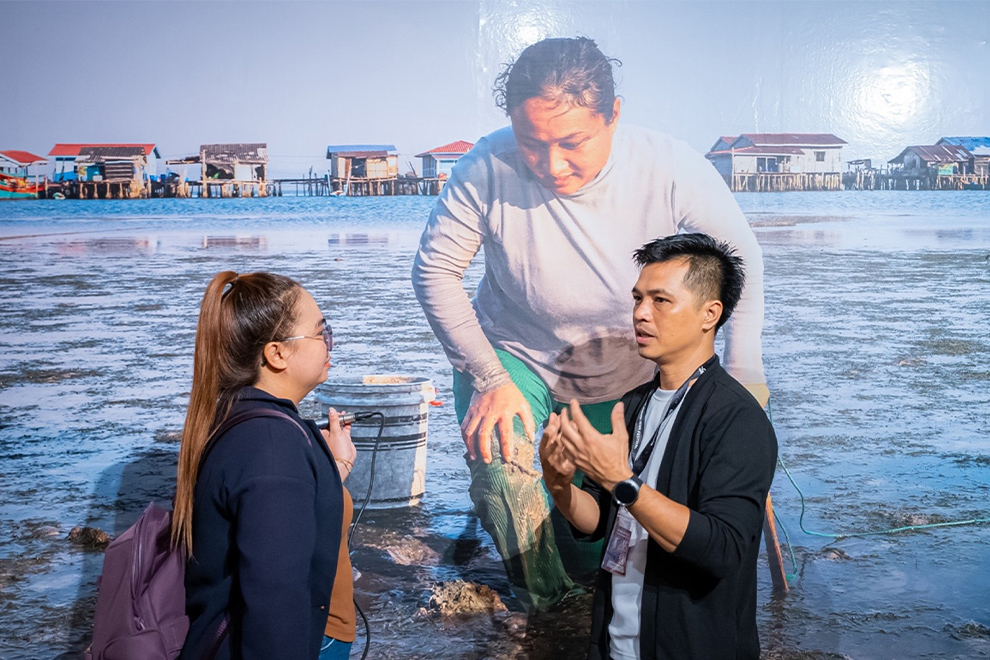
Cambodian photographer and president of the Photo Phnom Penh Association Sovan Philong speaks with a visitor in front of one of his large-scale prints from “Métis: Exploring Humanity's Ties to the Ocean”, his long-term project on the floating village of Avlatan. IFC/Photo Phnom Penh
“I spent a lot of time there and the more time I spend, the more I fall in love,” Sovan Philong says of Avlatan, an isolated fishing village where he's spent months photographing a community living above water on a one-kilometre wooden bridge. His project is one of dozens on view at Photo Phnom Penh's 16th edition. But while the festival sprawls across galleries, embassies and cultural centres throughout the capital, some exhibitions demand more than a tuktuk circuit allows – they require understanding the artists' processes, their reasons for making images and the questions they're asking about photography itself.
Three voices at this year's festival reveal how contemporary photographers are rethinking their medium's relationship to memory, place and community. Philong’s deep engagement with Avlatan. French photographer Letizia Le Fur's mythological reimagining of nature on the walls of the French Embassy. And curator Marie Le Mounier's vision for expanding what photography education can mean in Cambodia. Together they represent different approaches to a shared conviction: that photography can do more than document – it can transform how we see, remember and imagine our relationships with the world around us.
Photo Phnom Penh has occupied a particular position in Southeast Asia's cultural landscape since 2008. It functions as a platform where European and Asian photographers exchange ideas, where emerging Cambodian artists find their voice and where different genres of photography collide and cross-pollinate. This year's programme spans decades, from Micheline Dullin's 1960s documentation of Phnom Penh under King Norodom Sihanouk to contemporary projects addressing climate change and community identity. The theme running through all exhibitions: photography's relationship to memory – what images preserve and what they reshape.
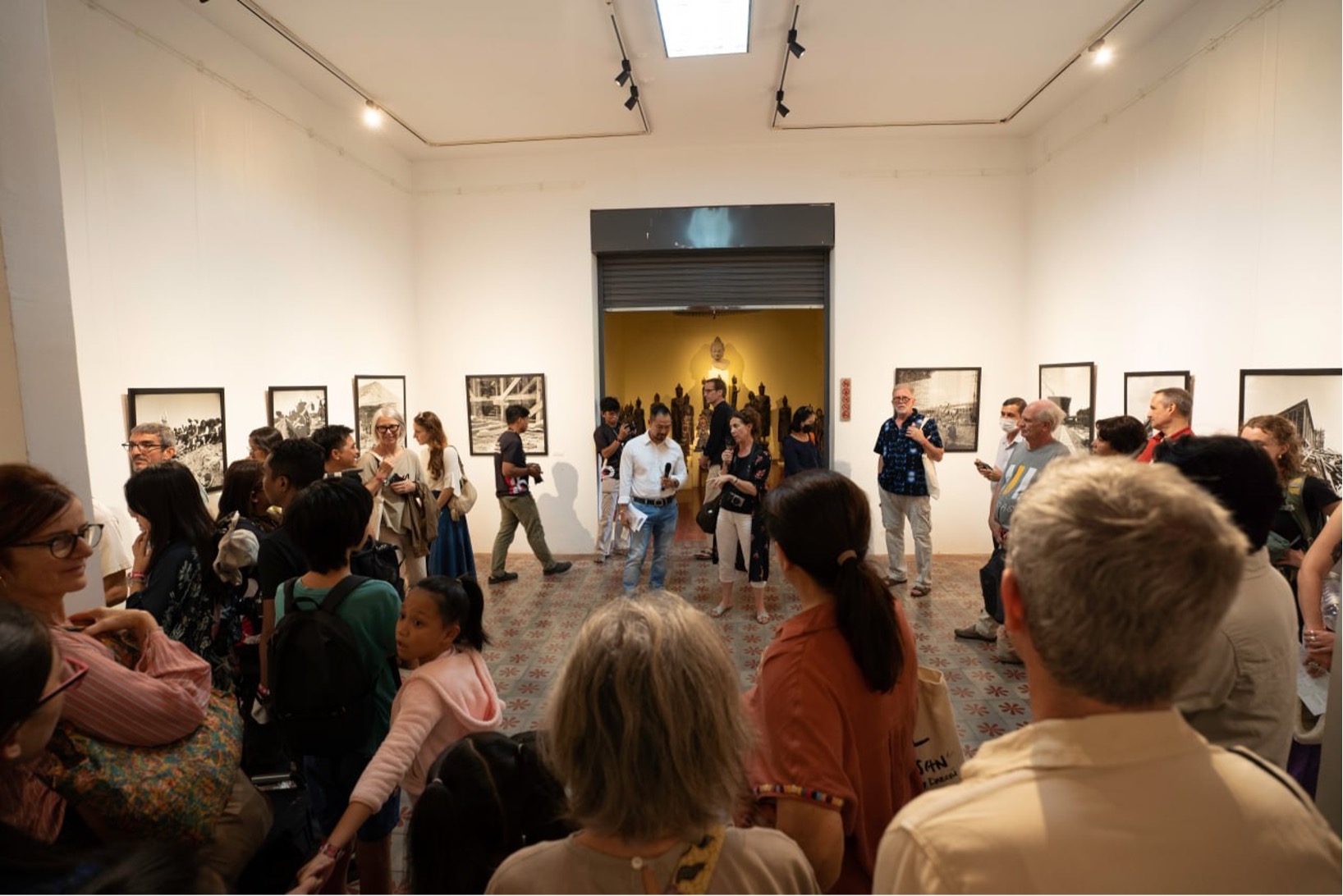
Visitors gather inside the National Museum of Cambodia for the opening of Micheline Dullin’s exhibition, featuring her 1960s photographs documenting Phnom Penh during the Prince Norodom Sihanouk era. IFC/Photo Phnom Penh
Excavating the city's past
At the National Museum of Cambodia – hosting the festival for the first time – Dullin's photographs offer a window into a Phnom Penh that exists now only in these frames. As official photographer to Prince Sihanouk from 1958 to 1964, she documented the capital's major construction projects: the Olympic Stadium designed by architect Vann Molyvann, the Japanese Bridge, the development along the Bassac waterfront. Her aerial views preserve buildings that have since vanished, including the White Building, that iconic apartment complex abandoned under the Khmer Rouge regime.
What distinguishes Dullin's work from standard architectural records is her attention to the human element. Even when individuals appear dwarfed by construction's scale, her lens remains attentive to workers, inhabitants and daily rhythms unfolding in the shadow of Cambodia's modernist ambitions. She used to say, “One should not define oneself as a photographer 'of'. One is a photographer.” In 1960s Phnom Penh, working in a profession rarely embraced by women, Dullin simply was the photographer.
Her images establish a baseline for this year's festival – a moment when the city was building itself into a modern capital, before the rupture of the Khmer Rouge years. They set the terms for what follows: how do we document, remember and reimagine places and communities through the camera's eye?
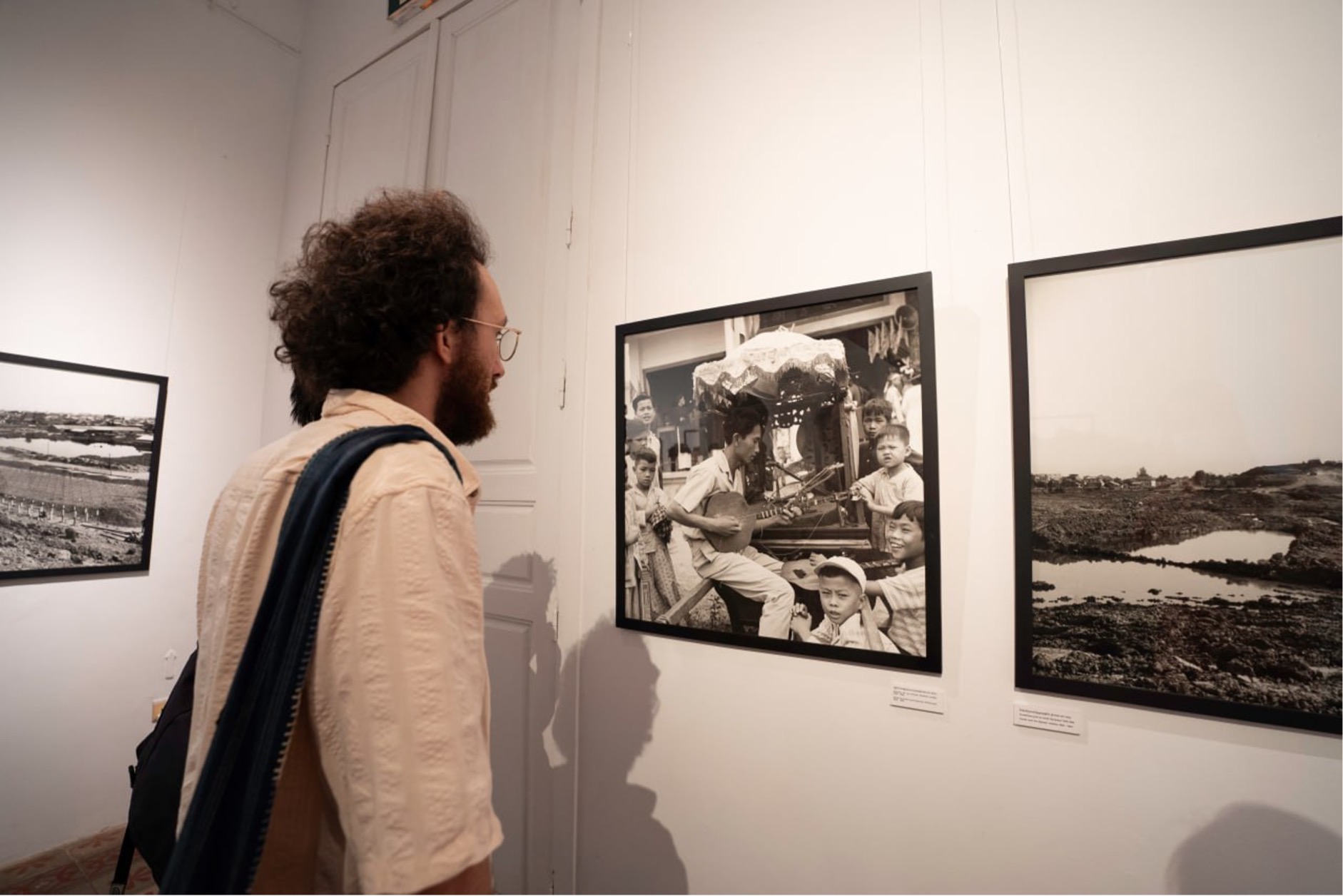
A visitor studies one of Micheline Dullin’s works on view at the National Museum of Cambodia, reflecting her distinctive eye for the city’s people and changing landscape. IFC/Photo Phnom Penh
Art as community archive
For Sovan Philong, preservation takes a different form. As president of the Photo Phnom Penh Association and director of Studio Images/Maison de la Photographie – the first school in Phnom Penh dedicated entirely to photography – he approaches the medium as both artistic practice and community service. His current project, part of the Métis exhibition at the French Institute, emerges from months spent in Avlatan, an isolated fishing village accessible only by boat, where a one-kilometre network of wooden bridges connects houses, a school and the pagoda, all above the waters of the Gulf of Thailand.
The Métis Fund, created by the French Development Agency (AFD), commissioned three Cambodian artists – Philong, video artist Khiev Kanel and performer Khun Vannak – to explore humanity's relationship with the ocean. What began as an artistic residency evolved into something more complex: workshops with children, archival photography projects with families and an attempt to use art as a catalyst for community development.
“At the beginning it was quite difficult because we didn't really know the feeling of the place,” Philong recalls. He had passed through the village two years earlier and found the bridge system intriguing, but living there revealed layers of isolation and intimacy that couldn't be captured in a single visit. “When you stay there more than two days, you feel really disconnected from society. If you don't use your smartphone, you don't have internet. You live just like them.”
The rhythm of the village shaped his approach. Women cooking at home, children walking to school, boats departing for night fishing, the changing quality of light across water and wood. Philong's photographs organise themselves around three focal points: life inside the houses, views through windows and doors that frame how residents see the sea and the ambient light that defines different times of day and weather conditions.
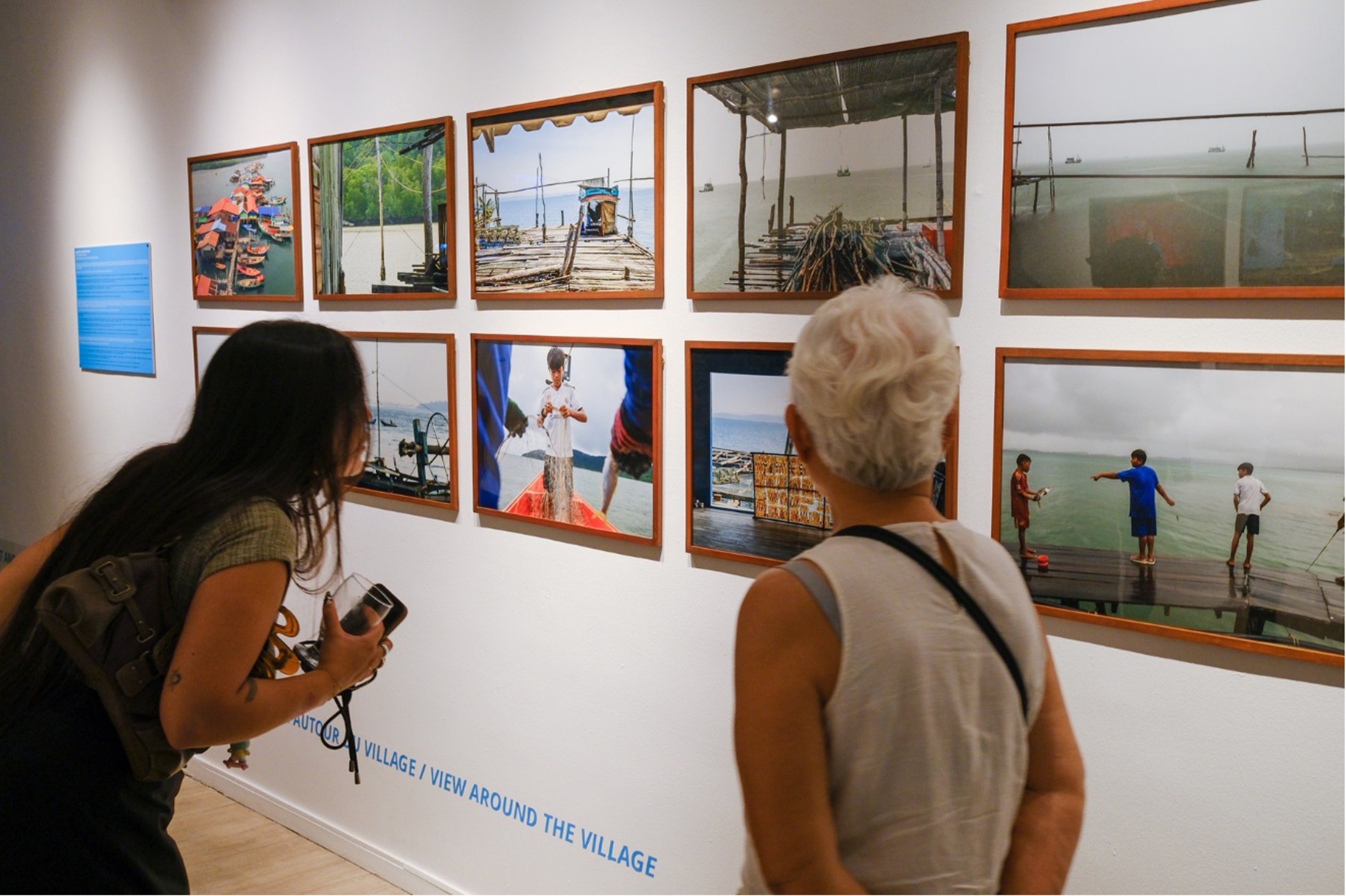
Visitors look closely at Sovan Philong’s photographs of daily life in Avlatan, where he spent months documenting the rhythms of a village suspended above the sea on a network of wooden bridges. IFC/Photo Phnom Penh
But simple photography wasn't enough. “I really wanted to bring out the story of these villagers,” Philong explains. “Most tourists pass by and don't understand anything about how the inhabitants live – they buy food, they buy souvenirs, then they leave. They don't know the conditions, the stories.”
The artistic intervention brought unexpected changes to Avlatan. Children learned performance, storytelling, photography, painting. One evening, the team projected everything the kids had created and parents who had never seen their children's work on screen gathered to watch.
“For the parents, it was amazing,” Philong says. The experience revealed possibilities beyond traditional fishing and recycling occupations. “When you teach through art, the kids understand more easily. They feel something. And that feeling is what can make change.”
Philong plans to return early next year to establish a permanent art centre in one of the village's empty houses – a space where young people could learn English, computer skills, photography and traditional arts.
“Many speak Thai because they are close to the Thai border, but they are Cambodian,” Philong notes. “So we must think about identity. Art can help them feel their tradition, their identity, their significance.”
“The voice of the media is very important – it can transform these places, bring them an audience,” he adds. “The village has its own smell, its own feeling – like cooking behind the houses, the boats coming right to the front door. That is the identity of the village. I spent a lot of time there and the more time I spend, the more I fall in love.”
That process of falling in love through extended attention distinguishes Philong's work from tourism or even traditional documentary photography. He's not extracting images; he's building relationships, infrastructure, futures. The photographs become records of that exchange – evidence that art can reshape what communities imagine for themselves.
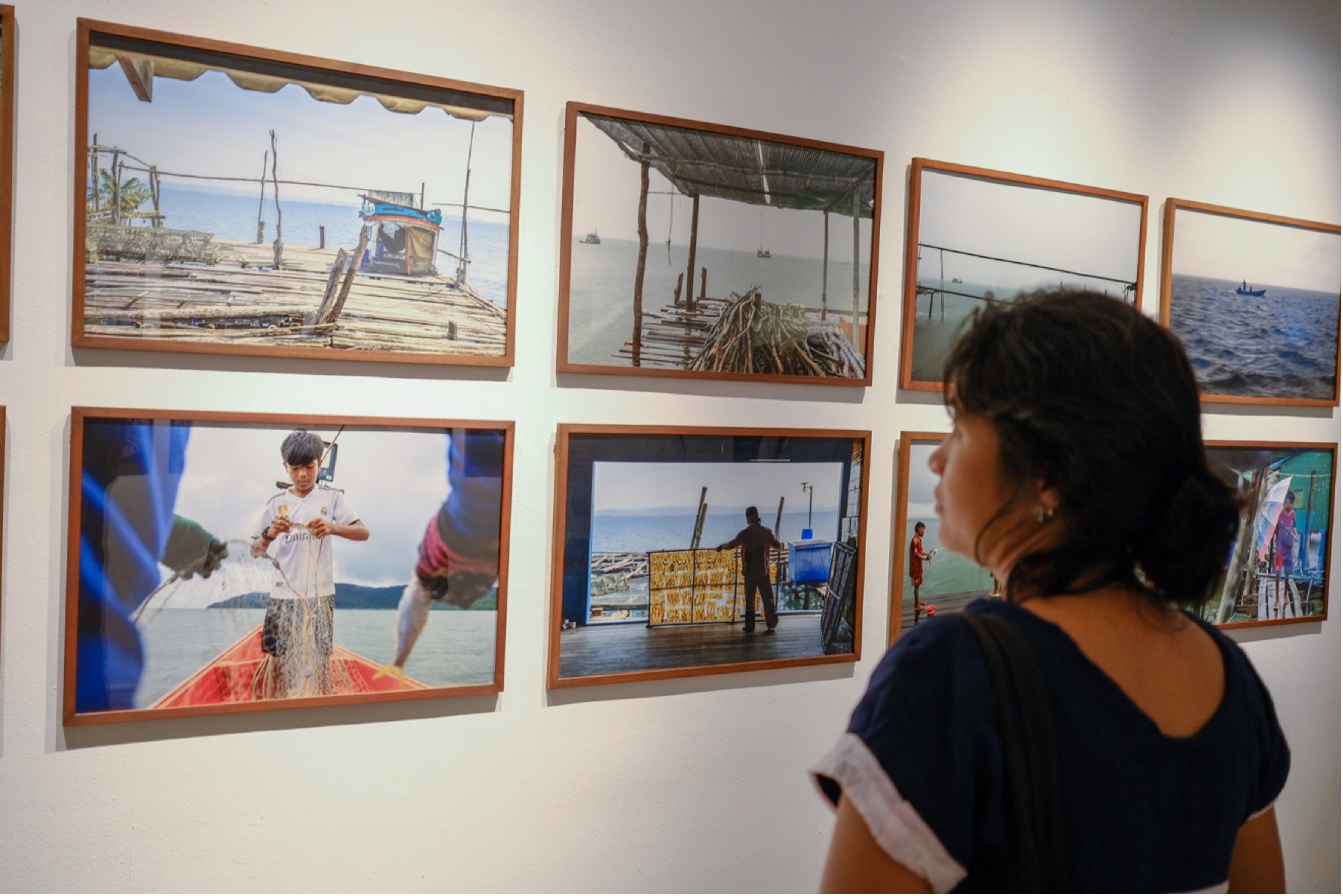
Philong’s Avlatan project explores the interplay of light, movement and the quiet routines that define everyday life in the community. IFC/Photo Phnom Penh
Nature as mythology
On the outer walls of the French Embassy, French photographer Letizia Le Fur presents “Mythologies,” a series that approaches nature through a radically different lens – one borrowed from ancient tales and refracted through contemporary ecological anxiety.
For Le Fur, myth provides a particular freedom. “Myth allows me to speak about the present without becoming didactic,” she explains. “It's a flexible, poetic form that can hold our fears, our hopes and our contradictions. By invoking these very ancient stories, I'm reminding us that our bond with the living world is nothing new: it has always been shaped by fascination, unease and a desire to understand.”
Le Fur's work moves through three movements: “The Origin” evokes primordial chaos through mineral landscapes and telluric forces; “The Golden Age” celebrates nature awakening in shimmering frescoes of regained harmony; “The Metamorphoses” explores transformation and instability. Her photographs, processed to intensify colors and light until they “tip into another dimension”, reject photography's documentary function in favour of a poetic space where reflection on the present takes shape.
First trained as a painter at the École des Beaux-Arts in Tours, Le Fur brings that sensibility to her photographic practice. “When I photograph, I think in terms of masses, colours, rhythms. I look for a kind of balance, but a living balance, one that could shift at any moment,” she says. “The post-production – very manual – extends that pictorial gesture. It's not retouching to smooth things out; it's a way of shaping the visual material, almost as one would with paint.”
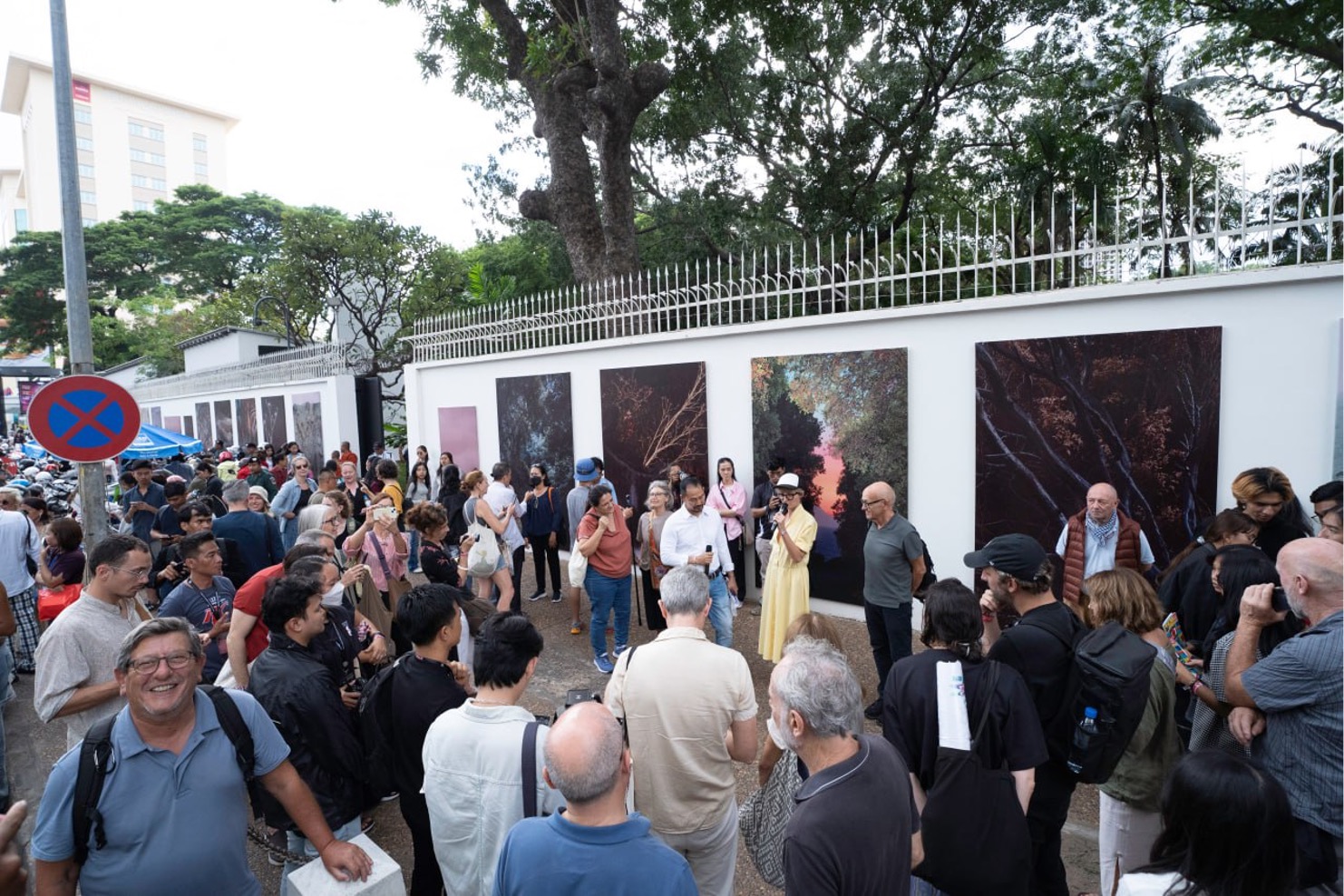
Letizia Le Fur’s outdoor installation “Mythologies” draws crowds to the walls of the French Embassy, where her reimagined landscapes reframe nature through colour, metaphor and mythic imagination. IFC/Photo Phnom Penh
Her choice to address ecological themes through beauty rather than alarm is deliberate. “Beauty can be an entry point into complexity, without overwhelming the viewer with anxiety. I don't aim to denounce or to moralise; I try to create images where one can linger, breathe, feel something,” Le Fur says. “It may sound a bit naïve, but I do believe that enchantment can shift perspectives in its own quiet way.”
The choice of the embassy walls carries particular resonance. During the chaos following the Khmer Rouge takeover of Phnom Penh, those walls sheltered hundreds of people. Now they host images of transfigured landscapes that function as mirrors held up to our times – an invitation to rethink relationships with nature, to question our fears and to imagine possible futures.
Le Fur didn't create the series specifically for the embassy, but designed the installation knowing the works would be shown outdoors. “I imagined a living scenography with shifting scales: some prints very large, almost monumental, others more intimate. I like this alternation because it creates a rhythm as people walk by.”
The outdoor setting means the images blend with their surroundings, shaped by the city, daylight and architectural constraints. “What I enjoy is that the images keep living beyond me,” she says.
Where Philong's work roots itself in a specific community over months of patient engagement, Le Fur's operates through suggestion and metaphor. Both approaches, however, share a belief that photography can do more than document – it can transform how we see, remember and imagine our relationships with the world around us.
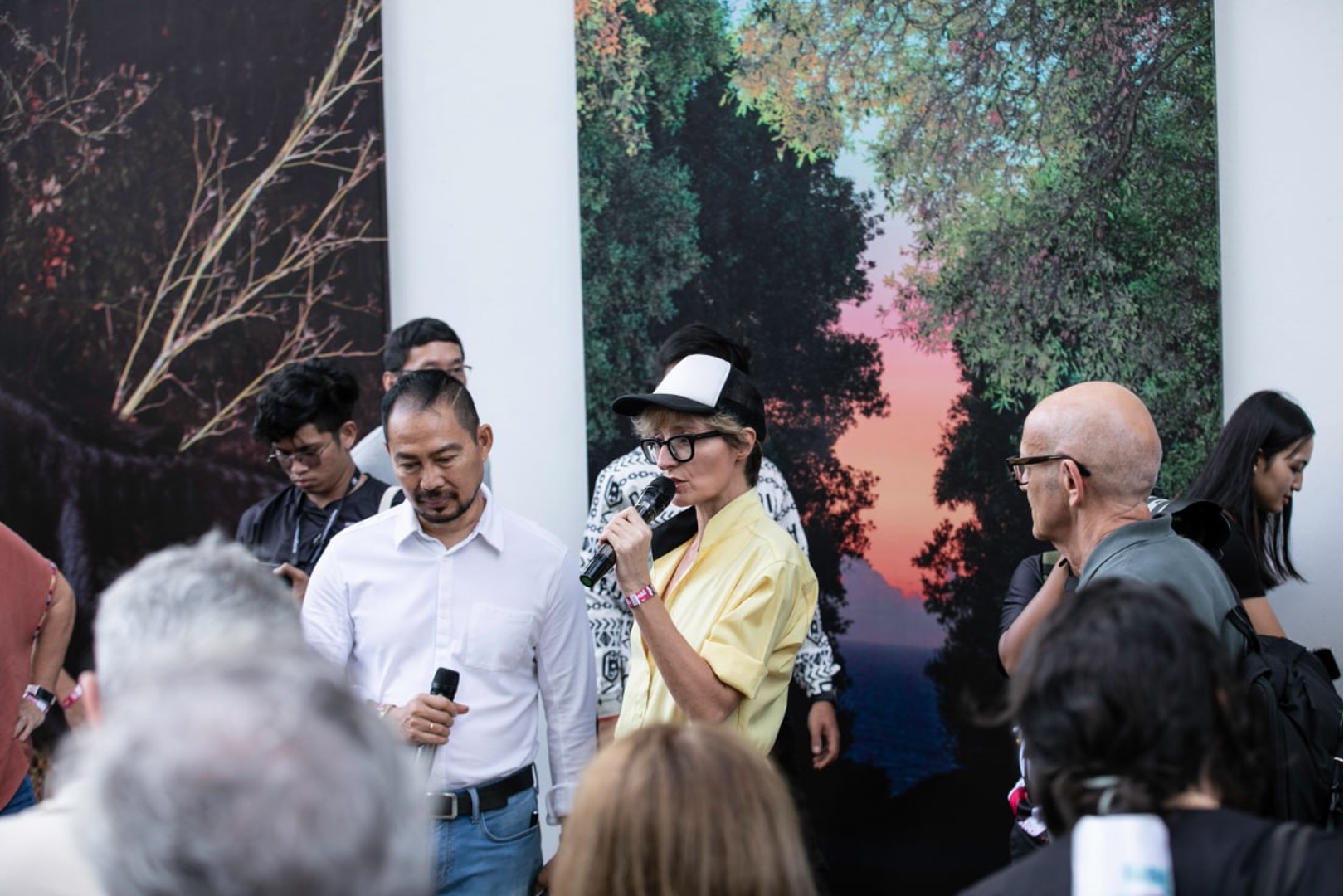
Photo Phnom Penh’s public programmes bridge artists, curators and audiences, underscoring the festival’s role as both exhibition platform and educational hub. IFC/Photo Phnom Penh
Expanding the frame
Behind the exhibitions, Photo Phnom Penh functions as artistic infrastructure. Studio Images/Maison de la Photographie, opened just a year ago by the association, now welcomes around twenty young Cambodians learning not just technical skills but ways of seeing.
Marie Le Mounier, one of the festival's curators alongside Beat Streuli and the late Christian Caujolle, sees this breadth as essential. “In Cambodia it's important to present a variety of time frames, supports, media and approaches, because access to culture is more limited,” she explains. “In Paris or elsewhere in Europe we have many museums, festivals, magazines, blogs – everything. So a broader content and larger approach make sense.”
The connection between festival and school runs deeper than administrative convenience. “The idea of having the festival attached to the school, or made by the same association, is that we create links between the two,” Le Mounier explains. “In the Global North we have specialised schools for teaching and learning arts or photography. In Cambodia there's not such broad access to photography education. So if we are restrictive in what we're presenting – if we just do artistic photography – then we miss the point.”
Photography, she argues, isn't like painting. “It's not just fine art, it's also media. Students are training in both. They're interested in several branches of photography, and they need to learn practical skills because they need to make a living.” Next year she'd like to include an exhibition on fashion. The festival becomes a teaching tool, exposing students to the full spectrum of what their medium can be.
Her approach to curating reflects this philosophy. “For me the dialogue between past and present is always important,” she says. “We tend to think of the present and future only in terms of progress, and that isn't always the best approach. We can learn from the past. As the historian Marc Bloch argued, you solve problems in the present by knowing the past.”
This year's edition marks a transition that acknowledges both continuity and change. Caujolle, who had curated the festival since 2008, passed away in October. A former director of Agence VU', the legendary photo agency, and the figure who introduced art photography to the French daily Libération in the late 1980s, Caujolle shaped the event's identity for over fifteen years. This year he worked alongside Le Mounier and Streuli as part of a curatorial team – a shift from the festival's previous model of a single curator.
“We're moving from a long period when a single curator led the programme to a broader curatorial team,” Le Mounier explains. “Along with that change, we must include Cambodian curatorial voices – or at least Southeast Asian curators. It cannot be only Western curators. That's a priority going forward.”
Over the coming months, she and Streuli plan to open a seminar on the festival's future, involving Cambodian artists, curators and Studio Images students in those discussions.
This year's selection of Cambodian artists emerged from recent projects that broaden what photography can encompass. “We selected three people who had just completed projects in collaboration with AFD. The projects were new and broad: Khun Vannak works between documentary and fiction; Khiev Kanel works with video-surveillance cameras; another project addresses family memories from the Khmer Rouge era. Together they broaden the audience's idea of what photography can be – documenting performance, interrogating surveillance, or more traditional approaches – which is inspiring for young photographers and students.”
Le Mounier herself will lead a December workshop on photography history, teaching not through lectures but through practice. “If we discuss the view camera, students will use a view camera,” she says. “It's practical and experimental rather than purely theoretical.”
What remains
What emerges from conversations with Philong, Le Fur and Le Mounier is an understanding of photography that extends beyond individual artistic vision and toward something more sustained and reciprocal. Whether Dullin spending hours alongside construction workers in the 1960s, Le Fur intensifying natural landscapes into mythological spaces, or Philong returning repeatedly to a fishing village until its rhythms become familiar – the work requires duration, patience, reciprocity.
Photo Phnom Penh positions itself at these intersections: between historical archives and contemporary creation, between documentary and fiction, between transmission and reinvention. The festival asks how images shape perception and memory, how they allow us to depict the world and potentially act upon it. In a city still processing its traumatic history while facing uncertain environmental and economic futures, these questions carry particular weight.
December 19 marks the festival's official close, although some exhibitions continue into January. The real work, though, extends far beyond any closing date. Philong will return to Avlatan to establish that art centre. Le Mounier and Streuli will convene their seminar on the festival's future. The photographs will remain. The children who learned to see their village through cameras will remember what it felt like when their work appeared on screen. The archives grow richer, and the conversation between past, present and future continues.