




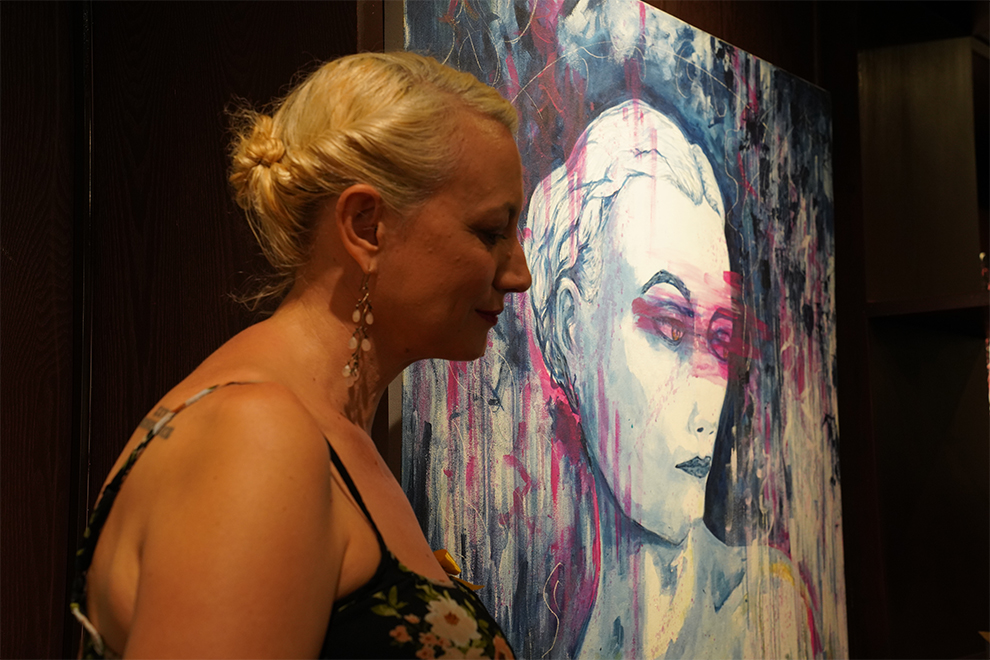
The exhibition also touches on more recent shared trauma through Emily Marques’ work Waiting to Be Together, which reflects the isolation and uncertainty experienced during the Covid-19 pandemic. Hong Raksmey
Identity, shaped by history, conflict and cultural memory, takes centre stage at the “Ekarieach All Stars” art exhibition, now open at Sofitel Phnom Penh Phokeethra, where Cambodian and international artists confront questions of belonging, loss and resilience — including reflections on Cambodian temples damaged during past Thai-Cambodian conflicts.
Founded in 2023 to mark Cambodia’s 70th anniversary of independence, Ekarieach, meaning “independence” in Khmer, has quickly established itself as a respected platform for both emerging and established artists.
After two themed editions — Independence (2023–2024) and Water (2024–2025) — the All Stars exhibition reunites selected finalists whose works have defined the competition’s evolution.
Rather than imposing a single narrative, the exhibition invites artists to interpret “identity” freely, resulting in a collection that is personal, political and deeply emotional.
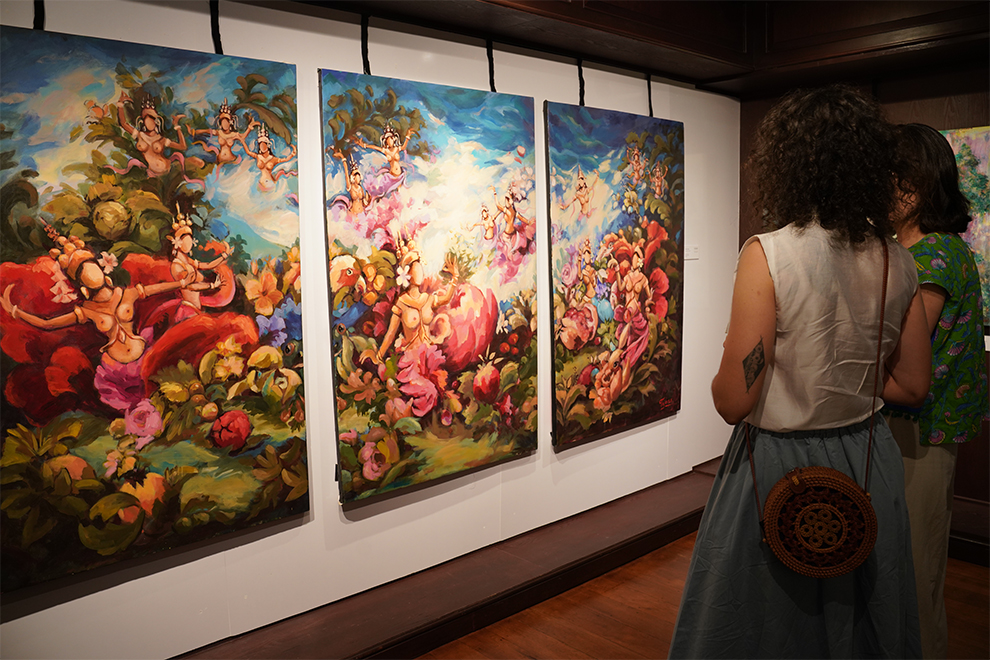
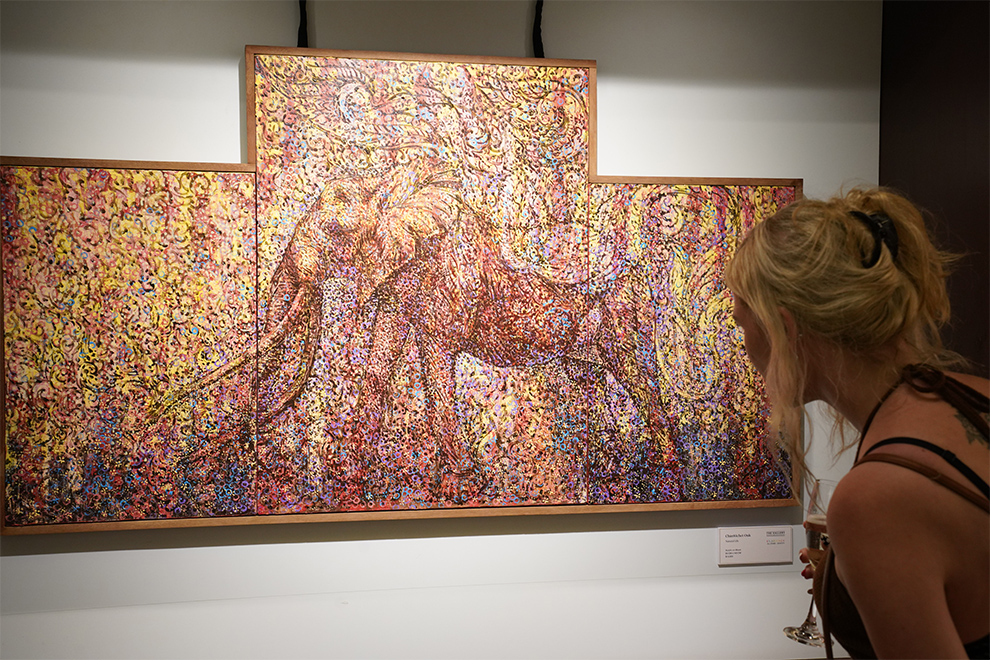
Visitors observe Rithy Heng’s artwork. Hong Raksmey
Sixty-nine artworks by 26 artists from eight nationalities are displayed across the gallery and hotel lobby.
Speaking at the opening ceremony, Marc Emmanuel, chief executive officer of Sofitel Phnom Penh Phokeethra, said the exhibition was designed to give artists space to express their individual voices in a world increasingly shaped by uniformity.
“Tonight, we asked each artist to bring their own signature and their own expression of identity,” he said. “Each artwork is a reflection of personal style and personality, and together they challenge and move us.”
One of the most striking works comes from Cambodian artist Soeung Vannara, whose painting Strong Stand directly addresses the destruction of Khmer temples during armed conflict.
The piece centres on Preah Vihear Temple, depicting its damaged gate in the shape of a dove’s head — a symbol of peace — set against the sun and moon to represent the continuity of time.
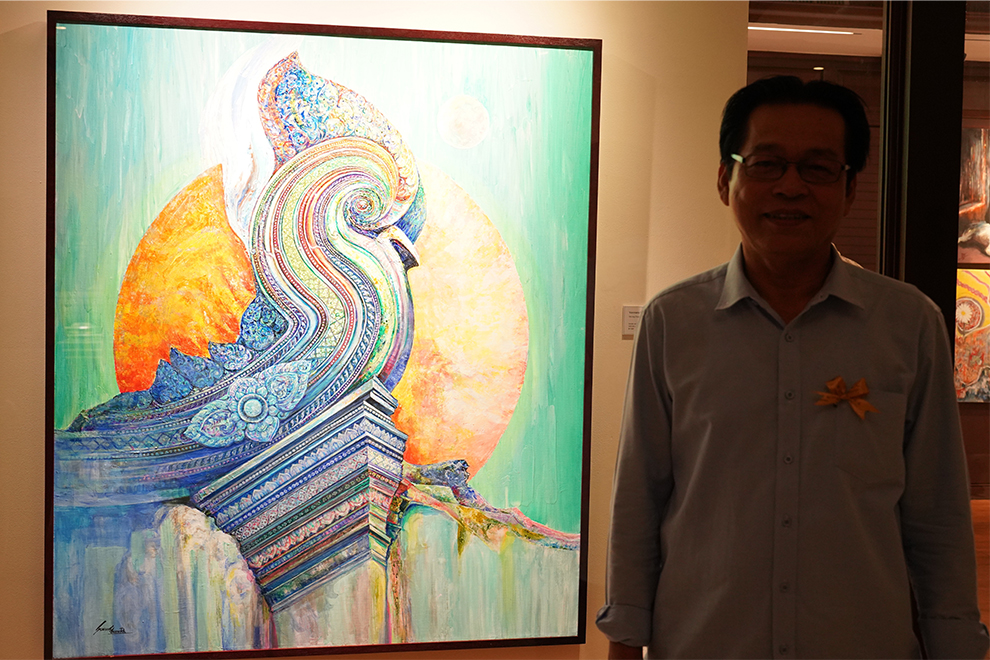
Soeung Vannara, whose painting Strong Stand directly addresses the destruction of Khmer temples during armed conflict. Hong Raksmey
“Even though the war has destroyed the Khmer temples, the Khmer people are still united in protecting our heritage because each stone is the soul of our ancestors,” Vannara told The Post.
He described the temple pedestal as representing both the ancestors who built Preah Vihear and the soldiers who sacrificed their lives defending the nation.
“Because we are hurt by the aggression, I have to express my pain through the exhibition to national and international visitors,” he said. “But I also want to show our strength in protecting the heritage.”
The exhibition also features works by Emily Marques. Originally from the US, whose painting Quiet Between Monsoons reflects on the Thai-Cambodian conflict through a quieter, contemplative lens.
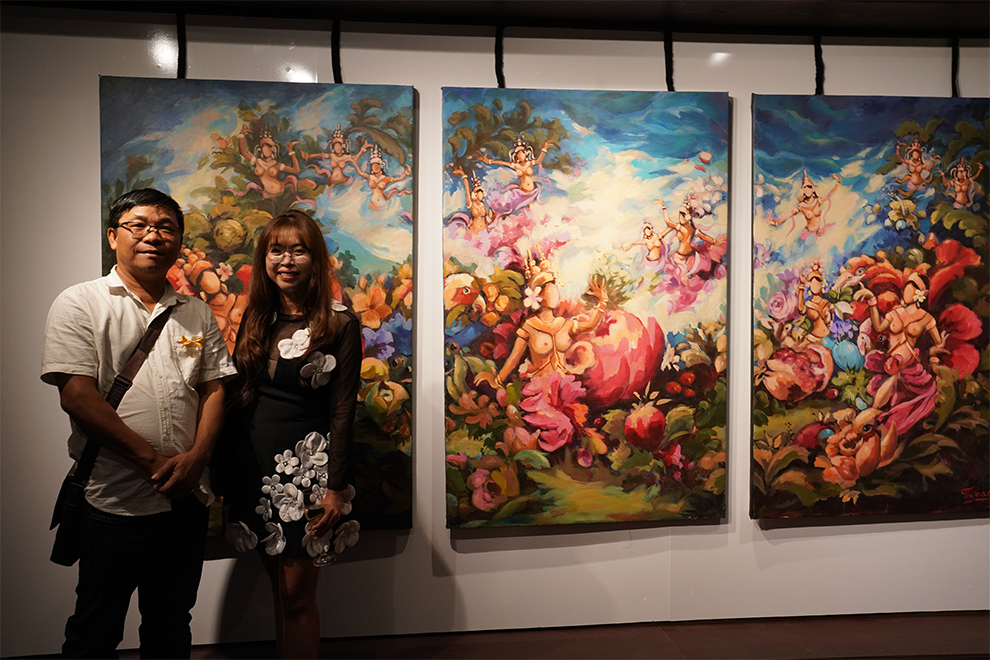
From Siem Reap, artist Rithy Heng (left) contributed three paintings in a single frame, combining flowers, animals and flying apsaras inspired by Angkor Wat. Hong Raksmey
Drawing on her experiences travelling throughout Cambodia, Marques said the work captures a moment of peace amid tension.
“I see the same beauty in the Khmer people that I see in the landscape,” she said. “I felt I needed to make a stand for how special Cambodia is and how beautiful the people are.”
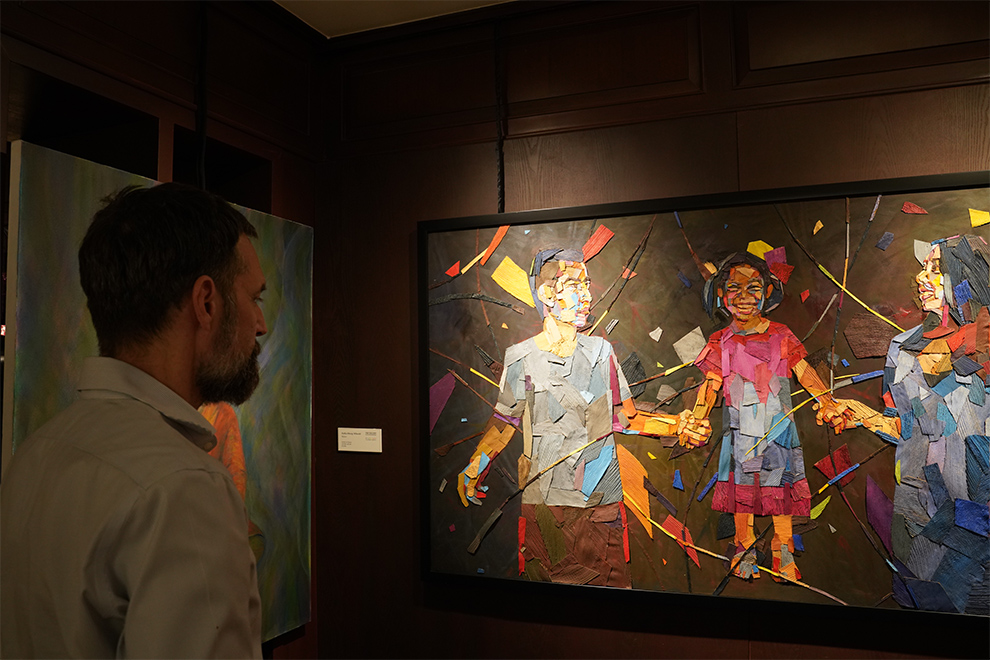
The exhibition also touches on more recent shared trauma through Marques’ work Waiting to Be Together, which reflects the isolation and uncertainty experienced during the Covid-19 pandemic.
The self-portrait captures what she described as the chaos surrounding individuals at the time, when isolation was necessary to protect oneself and others, yet the future remained unclear.
Marques said she symbolically painted a “rose-coloured gloss” over her eyes as a way of surviving difficult days and convincing herself that things would eventually be okay, despite not knowing what lay ahead.
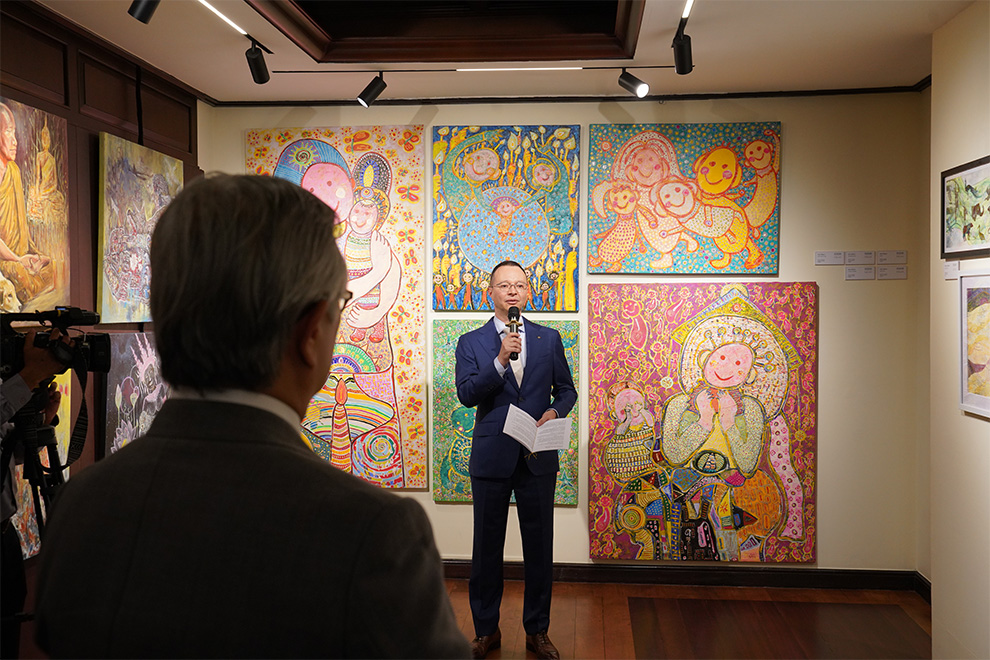
Marc Emmanuel, chief executive officer of Sofitel Phnom Penh Phokeethra, delivers his remarks at the “Ekarieach All Stars” exhibition. Hong Raksmey
The work also expresses the emotional weight of separation — waiting to reunite with friends, students and family living on another continent — highlighting what she called the “agony and heartache of waiting,” but also the belief that reunion ultimately makes the suffering worthwhile.
From Siem Reap, artist Rithy Heng contributes three paintings in a single frame, combining flowers, animals and flying apsaras inspired by Angkor Wat.
While rooted in traditional imagery, his approach deliberately challenges convention.
“I love flowers and Apsaras because I saw many of them at Angkor Wat,” he said. “But I wanted to arrange them differently to make them attractive and to test the public’s intelligence.”
Rithy also explained his decision to portray apsaras with unfamiliar features, diverging from their temple counterparts.
“I saw visitors touching the apsaras at Angkor Wat, and they were smooth,” he said. “I wanted to paint them in a European style. I want people to feel uncomfortable — to question what they think they know.”
Running from January 20 to February 28, 2026, the exhibition is open daily from 8am to 10pm, with free admission.
More than a showcase of artistic talent, Ekarieach All Stars offers an unfiltered reflection on Cambodia’s identity — one shaped by pride, pain, memory and an enduring determination to protect its cultural soul.